
Ultrasonic Cleaner Degas Function: When Does It Matter?
Learn what an ultrasonic cleaner degas function does, when buyers need it, how to test it on a supplier sample and what the feature cannot replace.

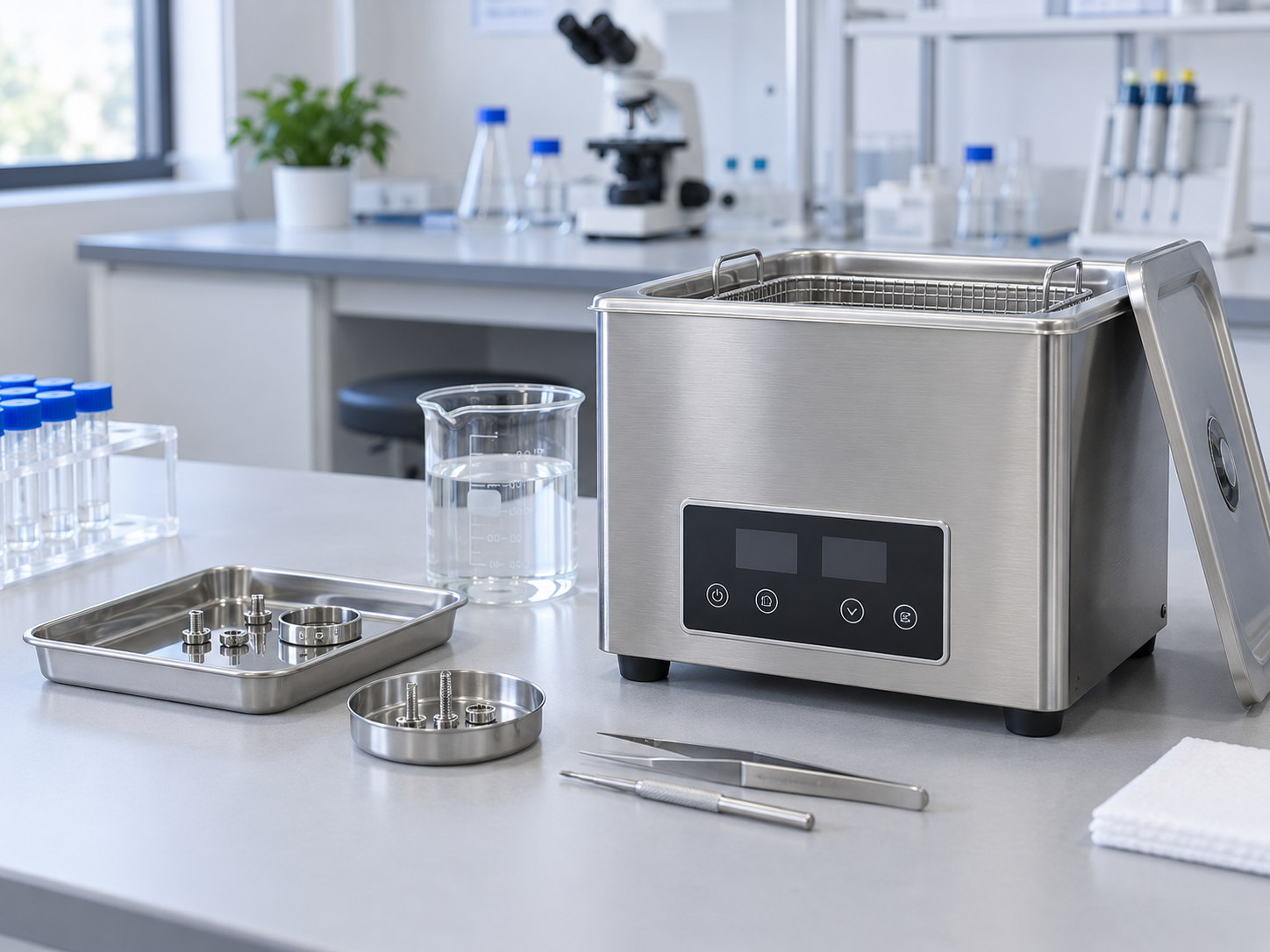
Quick answer: An ultrasonic cleaner degas function helps remove dissolved and trapped air from freshly prepared cleaning liquid so cavitation can develop more consistently. It is useful when buyers need repeatable results, frequently replace the bath or use the cleaner for laboratory and light-commercial work. It is not a disinfecting mode, and it does not replace the correct cleaning solution, cycle, loading method or application test.
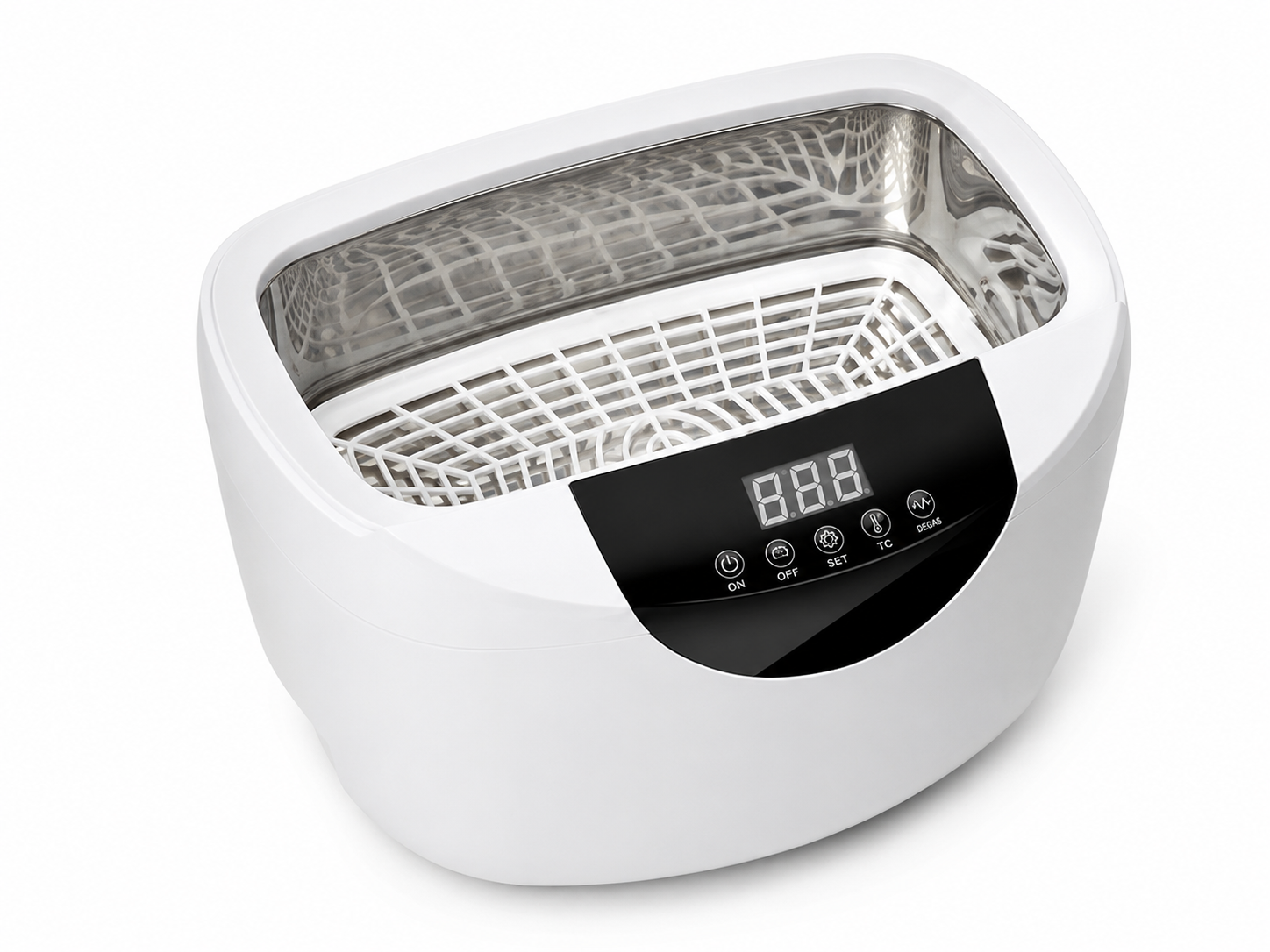
What does degassing mean in ultrasonic cleaning?
Fresh water and newly mixed cleaning solutions contain dissolved gases. Air can also become trapped when liquid is poured into a tank or when detergent is mixed. During ultrasonic operation, these gases can interfere with the formation and collapse of cavitation bubbles that provide the cleaning action.
Degassing prepares the bath before normal cleaning. Depending on the machine, a dedicated degas mode may pulse or vary ultrasonic operation to release gas more efficiently. Some equipment without a separate button can also degas a fresh bath by running ultrasound without a cleaning load for the period specified by the manufacturer.
The operating method is model-specific. Elma’s Elmasonic Easy R operating manual, for example, tells users to degas freshly prepared cleaning liquid before cleaning and provides instructions for that equipment. Follow the manual supplied with the cleaner rather than copying another model’s time setting.
Why should buyers care about the ultrasonic cleaner degas function?
More consistent starting conditions
If one cleaning trial uses freshly poured liquid and another uses a bath that has already operated for several cycles, the amount of dissolved gas can differ. Degassing the fresh bath using a controlled procedure helps remove one source of variation when comparing cycles or samples.
Faster preparation when liquid changes frequently
A dedicated mode can make the bath-preparation step clearer for operators who regularly replace water or cleaning solution. This may be valuable in laboratories, optical workshops, jewelry service counters, dental-related cleaning workflows and other settings where the bath is prepared repeatedly.
A feature that can be tested during sourcing
For distributors and private-label buyers, “degas” should be more than a button name. Ask the supplier to demonstrate the mode, explain the operating sequence and show how it differs from the normal cycle. Include the procedure in the user manual and sample-approval checklist.
Does every home ultrasonic cleaner need degas?
No. A compact household cleaner used for short, occasional cycles may still operate without a dedicated degas button. The buyer should consider the user, bath-change frequency, expected consistency and price position instead of treating one feature as universally necessary.
A degas function becomes more attractive when the product is marketed to frequent users, small businesses or buyers who prepare fresh solution often. It can also help a distributor offer a clearer step-by-step process. However, added controls should remain easy to understand; a feature that users cannot identify or operate correctly adds little value.
Degas mode versus running an empty ultrasonic cycle
| Method | What the buyer should verify | Important limitation |
|---|---|---|
| Dedicated degas mode | Mode sequence, duration options, display indication and instructions | The word “degas” alone does not prove performance |
| Normal ultrasound without a load | Manufacturer’s recommended preparation time and fill conditions | Do not invent a time or procedure not supported by the manual |
| Pre-degassed or previously operated bath | How bath age, temperature and chemistry are controlled | Results may not be comparable if other variables change |
Professional systems may offer much longer or adjustable degassing periods for cleaning or sample-preparation work. Branson’s official tabletop cleaner information, for example, describes a programmable degassing period on its laboratory-oriented CPX series. That does not mean a household cleaner needs the same controls; feature requirements should match the application.
What degassing does not do
- It does not sterilize or disinfect items. Do not use a degas label to support medical or antimicrobial claims.
- It does not select the correct chemistry. The cleaning solution must be suitable for the item, soil and tank.
- It does not correct overloading. Items still need appropriate immersion, spacing and liquid circulation.
- It does not prove cleaning performance. Buyers should test representative items using controlled conditions.
- It does not replace maintenance. Contaminated solution and a dirty tank can reduce process effectiveness.
How to evaluate a degas function on a supplier sample
- Lock the test conditions. Record liquid type, fill level, temperature, detergent concentration and starting condition.
- Follow the sample manual. Run the stated degas procedure without the cleaning load unless the manufacturer instructs otherwise.
- Observe the controls. Confirm that the user can distinguish degas from the normal cleaning cycle.
- Run a representative cleaning trial. Use the same item, soil, orientation and cycle for comparisons.
- Repeat the trial. Check whether results remain reasonably consistent across fresh-bath preparations.
- Review the instructions. The manual should explain when to use the mode and avoid unsupported safety or hygiene claims.
Visual bubbling alone is not a sufficient pass/fail test. Buyers should define what matters for their customers—visible residue removal, repeatability, cycle time, ease of use or another measurable requirement.
Example: compact 600mL cleaner with degas
The SONICLEANTECH GT-F2 600mL household ultrasonic cleaner lists 40kHz ultrasonic operation, 30W ultrasonic power, five timer settings, a degas function, a SUS304 stainless steel tank and an included basket. These specifications are specific to the GT-F2 and should be confirmed in the final purchase specification for an OEM or wholesale order.
Buyers who need a larger heated benchtop model can also review the 2.5L VGT-6250 ultrasonic cleaner. Compare capacity, tank dimensions, power supply, heating and workflow—not only whether both products use the word “degas.”
Questions to ask a supplier
- How does the degas mode operate on this exact model?
- What procedure and duration does the user manual recommend?
- Should degassing be performed whenever the liquid is replaced?
- Can the supplier demonstrate the mode on the production sample?
- Is the degas control included in every market version and private-label configuration?
- Which cleaning trials were used to evaluate repeatability?
- How are the mode, precautions and limitations explained in the manual?
Frequently asked questions
How long should an ultrasonic cleaner degas?
There is no universal time for every cleaner and application. Use the period and procedure stated in the equipment manual. Tank size, liquid, temperature and machine design can affect preparation.
Should items stay in the basket during degassing?
Normally, bath preparation is performed before the cleaning load is introduced, but buyers must follow the instructions for the specific model. Do not assume all machines use the same sequence.
Is a degas function the same as a cleaning cycle?
No. Degassing prepares the liquid. The normal cleaning cycle is then used with the suitable item, loading arrangement and cleaning conditions.
Does degassing make plain water clean everything?
No. It can improve bath preparation, but cleaning still depends on the item, contamination, solution, temperature, ultrasonic conditions and cycle. Read our ultrasonic cleaning solution guide before selecting chemistry.
Choose features around the real user
For an OEM, wholesale or distributor project, decide whether the end user needs occasional household cleaning or a more repeatable light-commercial workflow. Contact SONICLEANTECH with your intended items, target market, capacity, timer and customization requirements to compare suitable models.
Summary: An ultrasonic cleaner degas function prepares fresh cleaning liquid by removing dissolved and trapped gases that can interfere with cavitation. It can improve process consistency, but it is not a cleaning claim by itself. Buyers should verify the mode, instructions and representative cleaning results on the exact sample they plan to order.
[…] fresh solution as instructed. See our degas function guide for what this feature can and cannot […]
[…] Freshly prepared liquid contains dissolved gas that can weaken or delay cavitation. Run the machine’s degas function, or an unloaded ultrasonic cycle if the operating manual permits it, before starting a controlled cleaning cycle. For a deeper explanation, see our ultrasonic cleaner degas function guide. […]