
Heated vs No-Heat Ultrasonic Cleaner: How Should Commercial Buyers Choose?
A no-heating benchtop cleaner announcement in September 2026 raises a practical buying question: when does a commercial ultrasonic cleaner need a heater, and when is process-temperature control more important?

Quick answer: Choose a heated ultrasonic cleaner when your approved cleaning chemistry and process benefit from a controlled warm bath. Consider a no-heating model when the process requires an unheated solution or when temperature must be controlled separately. Do not assume a no-heating tank stays cool: ultrasonic operation itself can raise the liquid temperature, so measure the bath during representative cycles.
Why buyers are comparing heated and no-heating models
On September 24, 2026, an ultrasonic-cleaner supplier announced an expanded SUS316L benchtop series designed for no-heating precision-cleaning applications. This is one manufacturer’s product announcement, not evidence that a no-heat configuration is right for every process. It does make the decision timely for buyers comparing benchtop equipment and deciding which specifications matter.
For procurement teams, the key question is not “Which version is better?” but “Which temperature profile supports our cleaning chemistry, workpiece materials, and production routine?”
What does heating change in an ultrasonic cleaning bath?
A heater raises the solution toward a chosen setpoint before or during cleaning. Depending on the detergent and soil, a warm solution may help the cleaning process. The correct temperature is application-specific: detergent instructions, material limits, and any validated process requirements should guide the setpoint.
Ultrasonic energy also transfers heat into the bath. The Branson 3800 operating manual notes that ultrasonic operation adds heat to the solution and describes using warm solution, the heater, ultrasound, and a cover to reach temperature more quickly. This is why operators should monitor the actual bath temperature rather than assume the heater’s setting is the whole story.
When a heated ultrasonic cleaner may make sense
- Your cleaning-agent supplier specifies a working temperature range.
- The target soil and workpiece material have been tested at a warm temperature.
- Operators need a repeatable, adjustable setpoint across shifts or batches.
- The machine can preheat the liquid while operators prepare parts, reducing waiting during routine production.
Heating does not guarantee better results in every case. A warmer bath may be unsuitable for some materials, soils, or cleaning agents. Follow the chemical supplier’s instructions and test the complete process with representative parts.
When a no-heating model may be the better fit
- The process specification calls for ambient or otherwise unheated liquid.
- A separate system controls solution temperature more precisely.
- The workpiece or soil has a temperature limit that the process must respect.
- The buyer wants a simpler configuration and has confirmed that external temperature monitoring is practical.
A no-heating model removes the built-in heater, but it does not remove temperature change from the process. Long or repeated ultrasonic cycles can warm the bath. If temperature matters, specify how it will be measured and controlled during actual operation.
Five checks before choosing a commercial ultrasonic cleaner
1. Start with the cleaning agent
Ask the detergent or chemistry supplier for the recommended concentration, temperature range, and operating conditions. Do not select a heater setting from a general online rule of thumb.
2. Test the actual part and soil
Use representative workpieces, contamination, basket loading, and cycle time. Compare a heated and unheated trial only when the other conditions are held consistent. Record the bath temperature at the start and end of each cycle.
3. Define a temperature limit and tolerance
Tell suppliers the desired operating range and any maximum temperature for the parts or solution. Ask how the control system senses temperature, how the operator sees the reading, and what happens if the bath continues to warm during ultrasound.
4. Match tank size and workload
Choose by the largest part, basket arrangement, liquid volume, and number of items per cycle—not by nominal litres alone. For regular batch work, clarify warm-up time, cycle schedule, and how often solution is changed or topped up.
5. Request application evidence
Ask for a sample trial or documented test using your parts. A product label that says “heated,” “precision,” or “no-heat” is not a substitute for a test report that describes the conditions and outcome. For a quick check of bath activity, see our guide to the ultrasonic cleaner foil test; it does not replace an application-specific cleaning trial.
Buyer comparison
| Buyer requirement | Heated model | No-heating model |
|---|---|---|
| Set a warm bath using the machine | Built-in heater and temperature control may support this | Use a separately controlled solution if the process requires it |
| Follow chemistry supplier instructions | Confirm the detergent’s temperature range and allowed method | Confirm ambient-temperature use and measure the bath if needed |
| Manage temperature-sensitive parts | Set a limit and monitor temperature during ultrasound | Monitor temperature too; ultrasonic operation can still warm liquid |
| Compare cleaning performance | Run a representative, repeatable trial; compare results under documented conditions | |
Frequently asked questions
Does a heated ultrasonic cleaner always clean faster?
No. Results depend on the cleaning solution, soil, part material, bath conditions, and cycle. Use the chemistry supplier’s recommendations and compare representative test results.
Will a no-heating ultrasonic bath remain at room temperature?
Not necessarily. Ultrasound can warm the liquid during operation, especially over repeated or extended cycles. Measure the bath if temperature affects the process or workpiece.
Can I use the machine’s displayed setpoint as the exact bath temperature?
Use the equipment manual to understand how temperature is sensed and controlled. During a trial, verify the liquid temperature at relevant points in the cycle, particularly when ultrasound is running.
What information should I send when requesting a quotation?
Share part dimensions and materials, the contaminant, cleaning chemistry, temperature limits, daily workload, required basket size, and destination-market voltage. These details help the supplier recommend a suitable configuration.
Explore a commercial ultrasonic cleaner
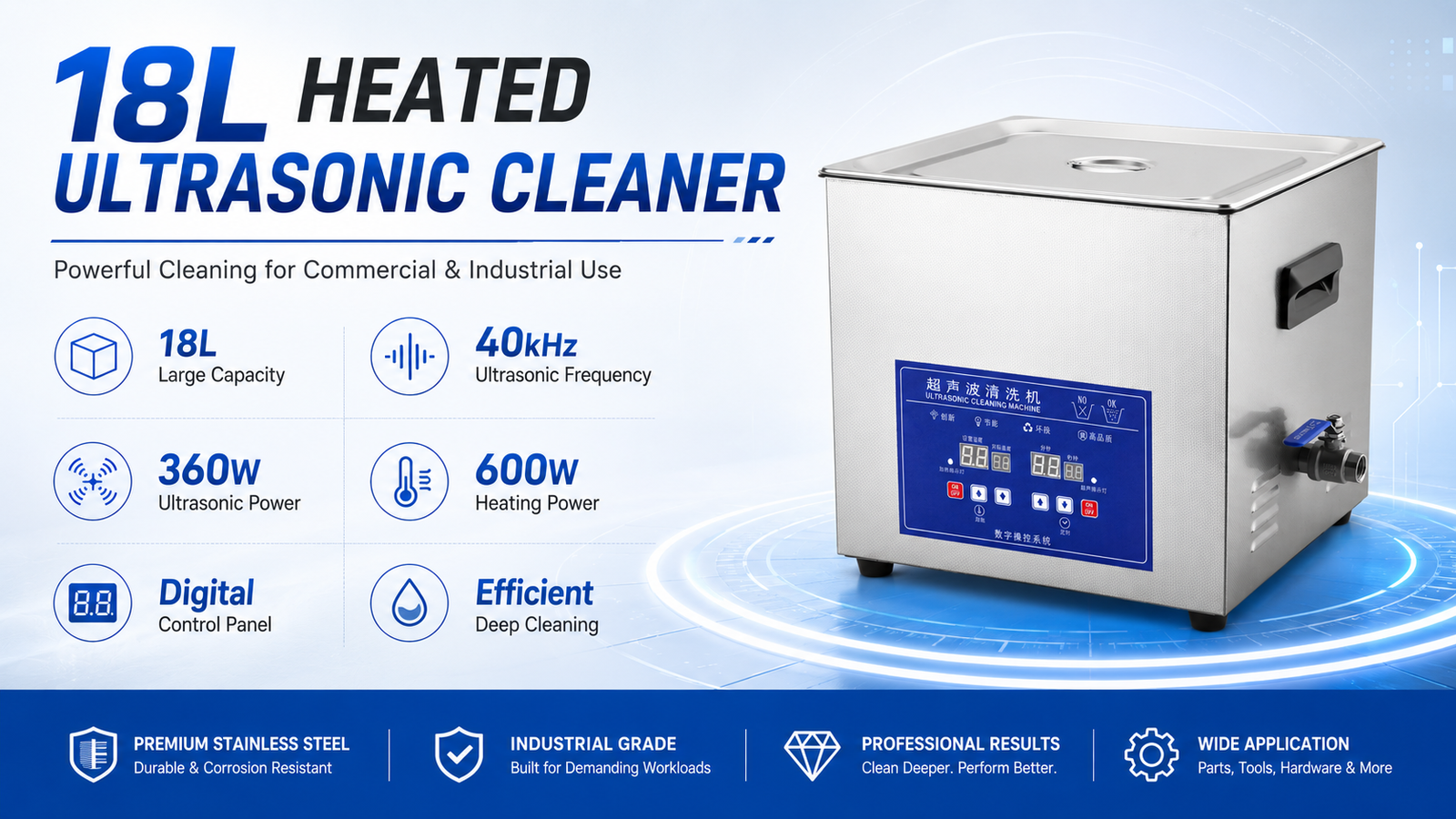
SONICLEANTECH’s 18L heated commercial ultrasonic cleaner is listed with a 40kHz frequency, 360W ultrasonic power, 600W heating power, digital controls, and an ambient-to-80°C temperature range. Confirm application suitability and specifications with our team before ordering. You can also read our guide to multi-frequency cleaning for laboratories and small businesses.
For a sample test, OEM/ODM inquiry, or commercial quotation, contact SONICLEANTECH with your part details, cleaning agent, target temperature, and expected order quantity.
Sources
- ACMESONIC announcement about its no-heating SUS316L benchtop series, September 24, 2026 (supplier announcement; product claims are not independent test results).
- Branson 3800 Ultrasonic Cleaner operating manual.
[…] the SONICLEANTECH 15L 40kHz commercial ultrasonic cleaner for a benchtop application, or read our heated versus no-heating buyer guide to compare process requirements. For a sample cleaning trial or quotation, contact SONICLEANTECH […]