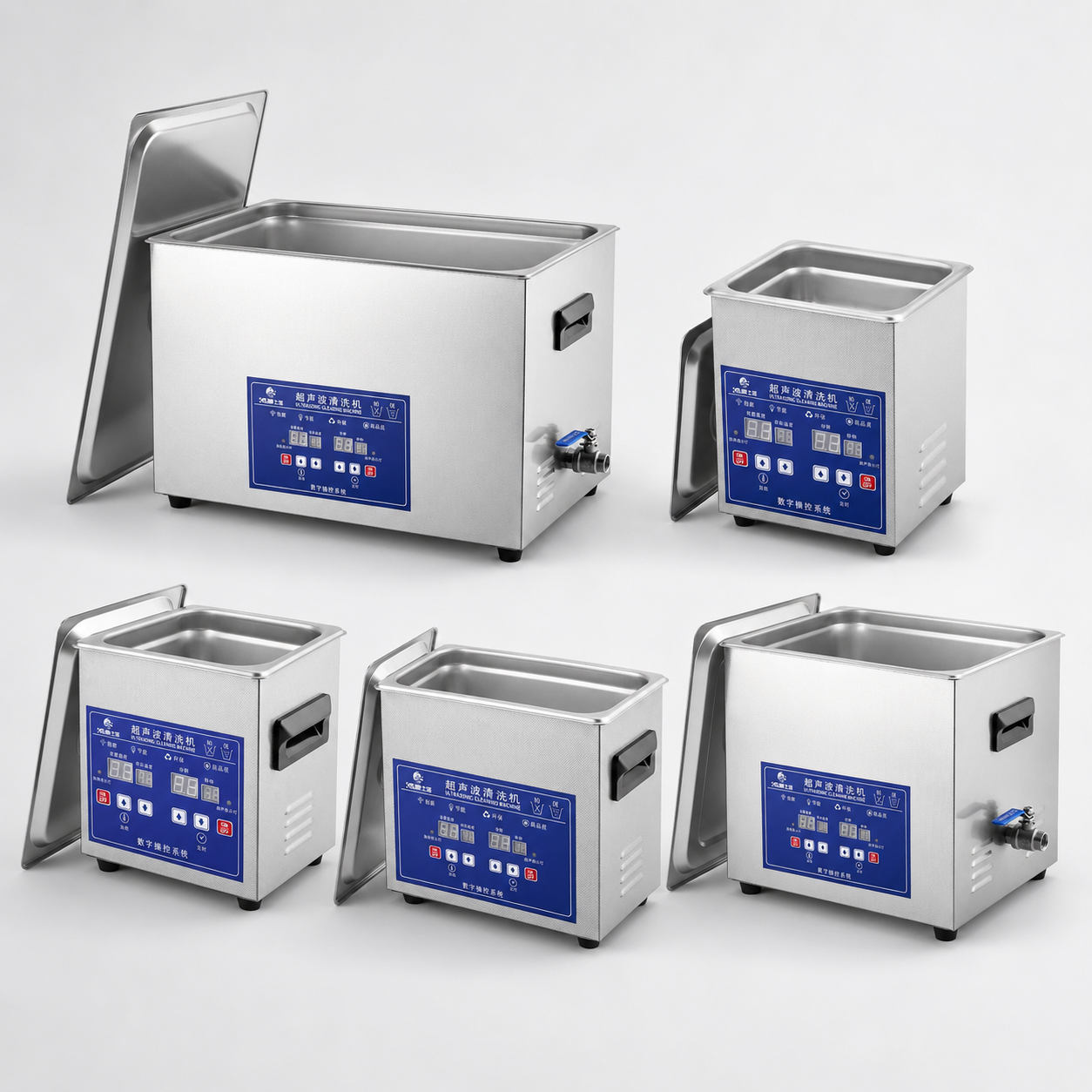
Single Frequency vs Multi-Frequency Ultrasonic Cleaner: Which One Should You Choose?

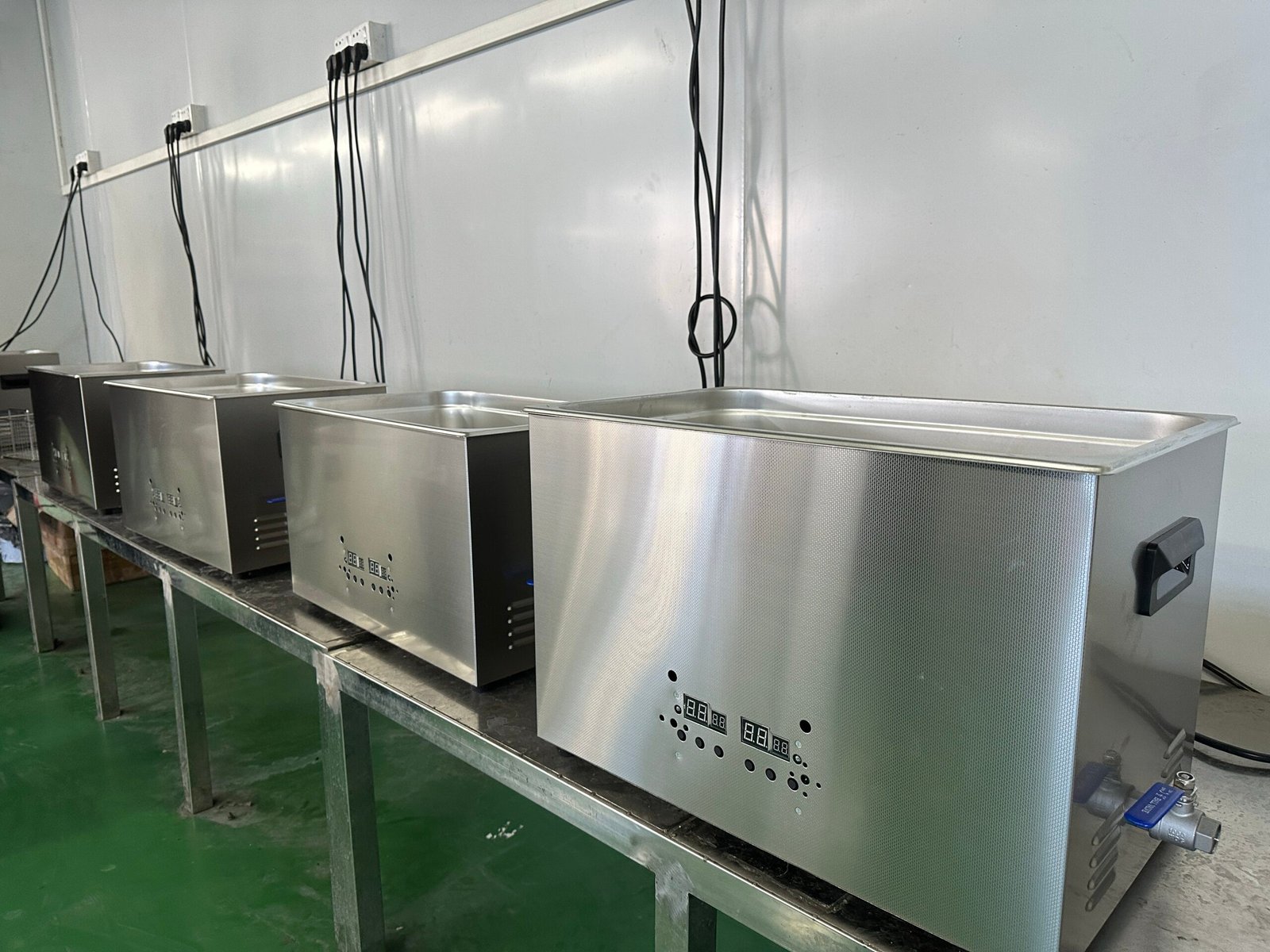
Introduction
Frequency selection is one of the most important factors when choosing an ultrasonic cleaner.
Different ultrasonic frequencies create different cavitation effects, which directly influence cleaning strength, precision, and application suitability.
In the market, ultrasonic cleaners are mainly divided into two types:
- Single frequency ultrasonic cleaners
- Multi-frequency ultrasonic cleaners
Some buyers believe that multi-frequency machines are always better because they offer more options. However, this is not always true.
The right choice depends on several factors, including:
- Type of contamination
- Material of the parts
- Cleaning precision requirements
- Production volume
- Application environment
This article explains the differences between single-frequency and multi-frequency ultrasonic cleaners, including their advantages, limitations, and suitable applications.
What Is Ultrasonic Cleaning Frequency?
Ultrasonic cleaning works by generating high-frequency sound waves in a liquid. These waves create millions of microscopic bubbles through a process called cavitation.
When these bubbles collapse, they produce small energy impacts that help remove:
- Oil
- Dust
- Grease
- Carbon deposits
- Flux residues
- Fine particles
The frequency determines the size and intensity of these cavitation bubbles.
Generally:
| Frequency Range | Main Characteristics |
|---|---|
| 20–30kHz | Strong cleaning force, suitable for heavy contamination |
| 35–45kHz | General-purpose industrial cleaning |
| 50–80kHz | More precise and gentle cleaning |
| Above 80kHz | Fine cleaning for delicate components |
Lower frequencies usually provide stronger cleaning power, while higher frequencies create smaller bubbles suitable for precision cleaning.
However, frequency is not the only factor affecting performance. Ultrasonic power, transducer quality, tank design, cleaning solution, temperature, and cleaning time also play important roles.
What Is a Single Frequency Ultrasonic Cleaner?
A single frequency ultrasonic cleaner operates at one fixed frequency.
Common examples include:
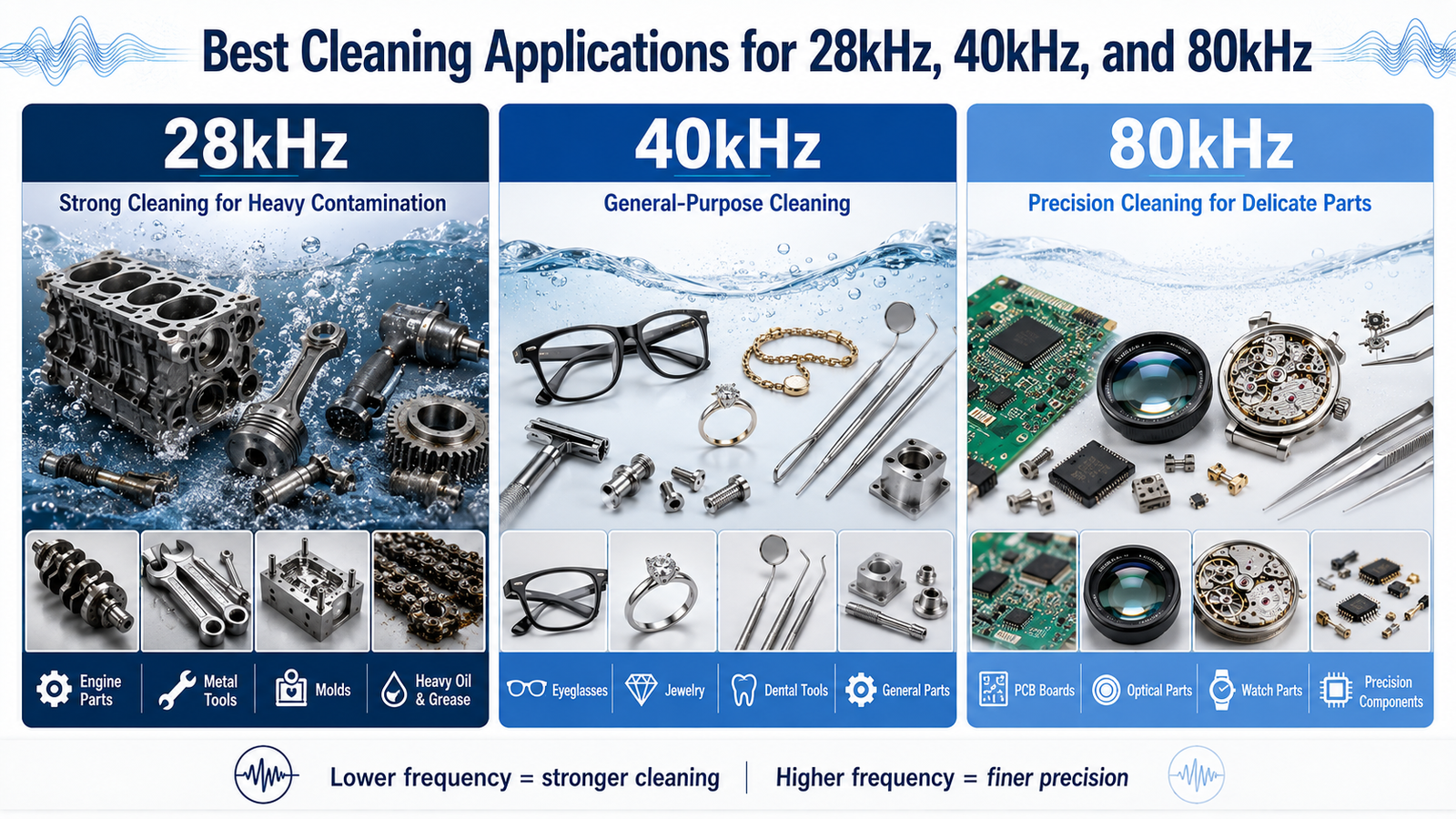
- 28kHz ultrasonic cleaner
- 40kHz ultrasonic cleaner
- 80kHz ultrasonic cleaner
The ultrasonic generator and transducers are designed specifically for that frequency.
For example:
A 28kHz system is commonly selected for removing heavy oil and contamination from metal parts, while a 40kHz system is widely used for general industrial cleaning.
Advantages of Single Frequency Ultrasonic Cleaners
1. Stable Cleaning Performance
Because the system is designed for one frequency, all components are optimized around a specific operating condition.
This allows manufacturers to achieve stable output and consistent cleaning results.
For companies cleaning the same type of products repeatedly, a dedicated single-frequency machine can provide reliable performance.
2. Lower Equipment Cost
Compared with multi-frequency systems, single-frequency ultrasonic cleaners usually have:
- Simpler electronic design
- Lower manufacturing cost
- Easier maintenance
For applications with clear cleaning requirements, a single-frequency machine can offer excellent cost efficiency.
For example, a factory producing the same automotive components every day may not need multiple frequency options.
3. Suitable for Dedicated Production Lines
Many industrial cleaning processes are highly standardized.
When the following factors remain unchanged:
- Same product type
- Same contamination level
- Same production process
a single frequency system can provide efficient and repeatable cleaning.
Typical applications include:
- Metal parts cleaning
- Automotive components
- Hardware cleaning
- Industrial maintenance
Limitations of Single Frequency Ultrasonic Cleaners
1. Limited Flexibility
The biggest limitation is that one frequency cannot perfectly match every cleaning requirement.
For example:
A low-frequency machine may provide strong cleaning force but may not be ideal for fragile precision components.
A high-frequency machine can protect delicate parts but may require longer cleaning time for heavy contamination.
2. Less Suitable for Diverse Applications
Companies that clean different products may need different cleaning conditions.
For example, a manufacturer handling both:
- Large metal components
- Small precision electronic parts
may find a fixed-frequency system less flexible.
What Is a Multi-Frequency Ultrasonic Cleaner?
A multi-frequency ultrasonic cleaner allows users to select different ultrasonic frequencies within one system.
A typical multi-frequency machine may support:
- 28kHz
- 40kHz
- 80kHz
Users can adjust the frequency according to different cleaning requirements.
For example:
- Low frequency for heavy contamination
- Medium frequency for general cleaning
- High frequency for precision components
Advantages of Multi-Frequency Ultrasonic Cleaners
1. Greater Application Flexibility
The main advantage of multi-frequency technology is adaptability.
One machine can handle different cleaning tasks without requiring separate equipment.
For companies serving multiple industries or processing different products, this flexibility can be valuable.
Applications include:
- Electronics
- Laboratories
- Precision manufacturing
- Medical components
- Optical parts
2. Better Control Over Cleaning Results
Different contamination types require different cleaning approaches.
For example:
Heavy oil and industrial grease may require stronger cavitation.
Small precision components may require gentler cleaning to avoid surface damage.
Multi-frequency systems allow operators to adjust the cleaning process according to the product.
3. Suitable for Product Development and Custom Applications
Manufacturers, laboratories, and OEM cleaning service providers often work with different materials and products.
A multi-frequency ultrasonic cleaner allows them to test different cleaning parameters before establishing a final process.
This makes it useful for:
- Research applications
- New product development
- Customized cleaning solutions
Limitations of Multi-Frequency Ultrasonic Cleaners
1. Higher Initial Investment
Because multi-frequency systems require more advanced:
- Ultrasonic generators
- Control systems
- Circuit designs
their cost is generally higher than standard single-frequency machines.
For simple cleaning applications, the additional investment may not always be necessary.
2. More Technical Operation
More options also mean more decisions.
Operators need to understand:
- Which frequency to use
- Appropriate cleaning time
- Suitable power level
Incorrect settings may reduce cleaning efficiency.
3. Not Always the Best Choice
A common misunderstanding is that more frequencies automatically mean better cleaning.
In reality, a well-designed single-frequency ultrasonic cleaner can outperform a multi-frequency machine in a specific application if the frequency is correctly selected.
The best equipment is the one that matches the actual cleaning requirement.
Single Frequency vs Multi-Frequency Ultrasonic Cleaner Comparison
| Feature | Single Frequency | Multi-Frequency |
|---|---|---|
| Cleaning flexibility | Limited | Excellent |
| Equipment cost | Lower | Higher |
| Operation | Simple | Requires more knowledge |
| Maintenance | Easier | More complex |
| Dedicated production | Excellent | Good |
| Multiple products | Limited | Excellent |
| Custom applications | Moderate | Excellent |
Which Ultrasonic Cleaner Should You Choose?
Choose a Single Frequency Ultrasonic Cleaner If:
A single-frequency machine may be the better choice when:
- You clean the same products regularly
- The contamination type is predictable
- Production conditions are stable
- Cost efficiency is important
Examples:
- Automotive parts factories
- Hardware manufacturers
- Industrial component cleaning
Choose a Multi-Frequency Ultrasonic Cleaner If:
A multi-frequency system may be more suitable when:
- You clean different types of products
- Precision cleaning is required
- Your applications change frequently
- You need flexibility for future development
Examples:
- Laboratory applications
- Electronics manufacturing
- OEM cleaning services
- Precision industries
Conclusion
Both single-frequency and multi-frequency ultrasonic cleaners have their own advantages.
A single-frequency ultrasonic cleaner provides stable performance, lower cost, and excellent efficiency for dedicated applications.
A multi-frequency ultrasonic cleaner provides greater flexibility and is suitable for companies with diverse cleaning requirements.
There is no universal “best” ultrasonic cleaning frequency. The ideal solution depends on your products, contamination type, cleaning goals, and production requirements.
At SONICLEAN TECH, we provide customized ultrasonic cleaning solutions, including single-frequency and multi-frequency ultrasonic cleaners for industrial, commercial, and OEM applications.
Whether you need a standard ultrasonic cleaner or a customized cleaning system, our team can help you select the right technology for your application.
Contact SONICLEAN TECH for professional ultrasonic cleaning solutions.