
Can Ultrasonic Cleaners Really Remove Bacteria From Retainers?

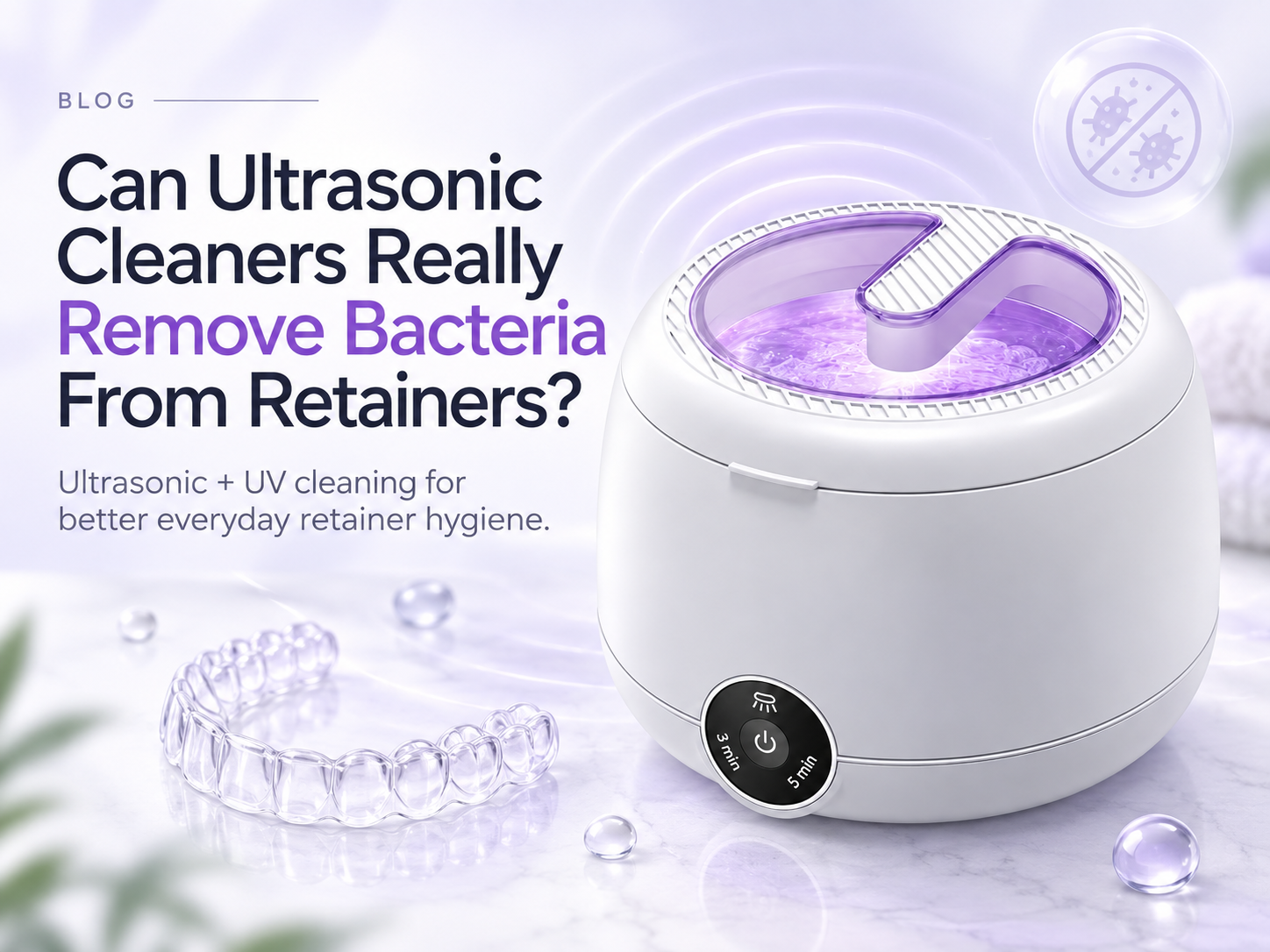
An ultrasonic cleaner for retainers is becoming a popular way to remove plaque, biofilm and everyday buildup from clear retainers. But one question matters most to many users:
Can ultrasonic cleaning actually remove bacteria from a retainer?
The answer is yes—but with an important distinction.
Ultrasonic cleaning can help remove bacteria-containing biofilm, plaque, saliva residue and other contamination from the retainer surface. However, ultrasonic cleaning alone should not be described as complete sterilization.
Why Retainers Develop Bacteria and Odor
Retainers spend hours in direct contact with saliva and the oral environment.
Even when a retainer looks clean, microorganisms and organic residue can accumulate on its surface. Over time, this buildup may contribute to:
- unpleasant odors
- cloudy-looking retainers
- plaque and biofilm
- difficult-to-clean deposits
- a less fresh feeling when wearing the retainer
Simply rinsing the appliance under running water often removes loose particles, but it may not effectively reach grooves, edges and tooth-shaped recesses.
This is where ultrasonic cleaning becomes useful.
How Does an Ultrasonic Cleaner for Retainers Work?
An ultrasonic cleaner for retainers uses high-frequency sound waves to create microscopic bubbles in water.
These bubbles rapidly form and collapse in a process known as cavitation.
The resulting cleaning action reaches around the entire retainer and helps loosen contamination from areas that may be difficult to clean with a toothbrush.
Instead of relying only on manual scrubbing, ultrasonic cleaning can target:
Biofilm → plaque → saliva residue → food debris → surface buildup
This makes it particularly suitable for clear retainers, aligners and other dental appliances with small grooves and complex surfaces.
Can Ultrasonic Cleaning Reduce Bacterial Contamination?
Recent research provides useful evidence.
A 2026 clinical study examined different cleaning methods for thermoplastic orthodontic retainers. Researchers found that ultrasonic cleaning combined with chlorhexidine produced the lowest microbial contamination among the methods tested.
Interestingly, ultrasonic cleaning with water alone did not perform as well as ultrasonic cleaning combined with the cleaning solution.
This tells us something important:
Ultrasonic action is very useful for physically removing contamination, while an appropriate cleaning solution can provide additional antimicrobial support.
For everyday users, however, any cleaning solution should be compatible with the retainer material and used according to the appliance manufacturer’s or dental professional’s instructions.
Ultrasonic Cleaning Is Not the Same as Sterilization
This is an important point when choosing a retainer cleaning machine.
An ultrasonic cleaner is primarily a cleaning device.
Its cavitation action helps loosen and remove contamination from the appliance surface, but that does not mean every microorganism is destroyed.
A more accurate description is:
Ultrasonic cleaning helps reduce microbial contamination by removing the biofilm and debris where microorganisms accumulate.
That is also why regular cleaning matters. Removing buildup before it becomes heavy is easier than trying to restore a retainer that has already become heavily coated or stained.
What About a UV Ultrasonic Retainer Cleaner?
Some newer ultrasonic retainer cleaners include UV light to provide an additional hygiene step after or during ultrasonic cleaning.
The two technologies perform different jobs.
Ultrasonic Cleaning
Ultrasonic cavitation is mainly responsible for physical cleaning.
It helps remove:
- plaque
- biofilm
- food particles
- saliva residue
- hard-to-reach debris
UV Cleaning
UV-C light can help inactivate microorganisms that receive sufficient UV exposure.
Germicidal UV is commonly associated with wavelengths around 240–280 nm, but its effectiveness depends on factors such as wavelength, intensity, exposure time, distance and whether dirt or other material blocks the light.
That means UV works best as a supplementary hygiene feature, rather than a replacement for physical cleaning.
Why Combine Ultrasonic Cleaning With UV?
This is where a UV ultrasonic cleaner for retainers can become more attractive.
Ultrasonic cleaning first helps remove physical contamination and biofilm from the retainer.
UV then provides an additional antimicrobial step for surfaces that are adequately exposed to the UV light.
In simple terms:
Ultrasonic = Remove the buildup
UV = Additional microbial inactivation
The combination can provide a more complete cleaning routine than relying on rinsing alone.
However, because UV effectiveness depends heavily on exposure and device design, a UV-equipped cleaner should still not automatically be described as providing complete medical sterilization.
Water or Cleaning Solution: Which Is Better?
For routine use, clean water can help ultrasonic cavitation remove loose debris and surface buildup.
For deeper cleaning, some users may choose an appropriate retainer-safe cleaning solution.
Clinical research suggests that combining ultrasonic cleaning with a suitable antimicrobial agent can reduce microbial contamination more effectively than ultrasonic cleaning with water alone.
However, avoid assuming that stronger chemicals mean better cleaning.
Do not use substances such as bleach, strong alcohol-based solutions or aggressive household detergents unless the retainer manufacturer specifically permits them.
Very hot water should also be avoided because some thermoplastic retainers can deform under excessive heat.
A Simple Daily Retainer Cleaning Routine
A good routine does not need to be complicated.
After removing the retainer, rinse away loose saliva and debris.
Place it inside your ultrasonic retainer cleaner with clean water and run the recommended cleaning cycle.
If appropriate, use a retainer-compatible cleaning solution according to its instructions.
For a cleaner equipped with UV, the UV function can provide an additional hygiene step.
Finally, rinse the retainer thoroughly before placing it back in your mouth.
Most importantly, clean it regularly rather than waiting until visible deposits or odor appear.
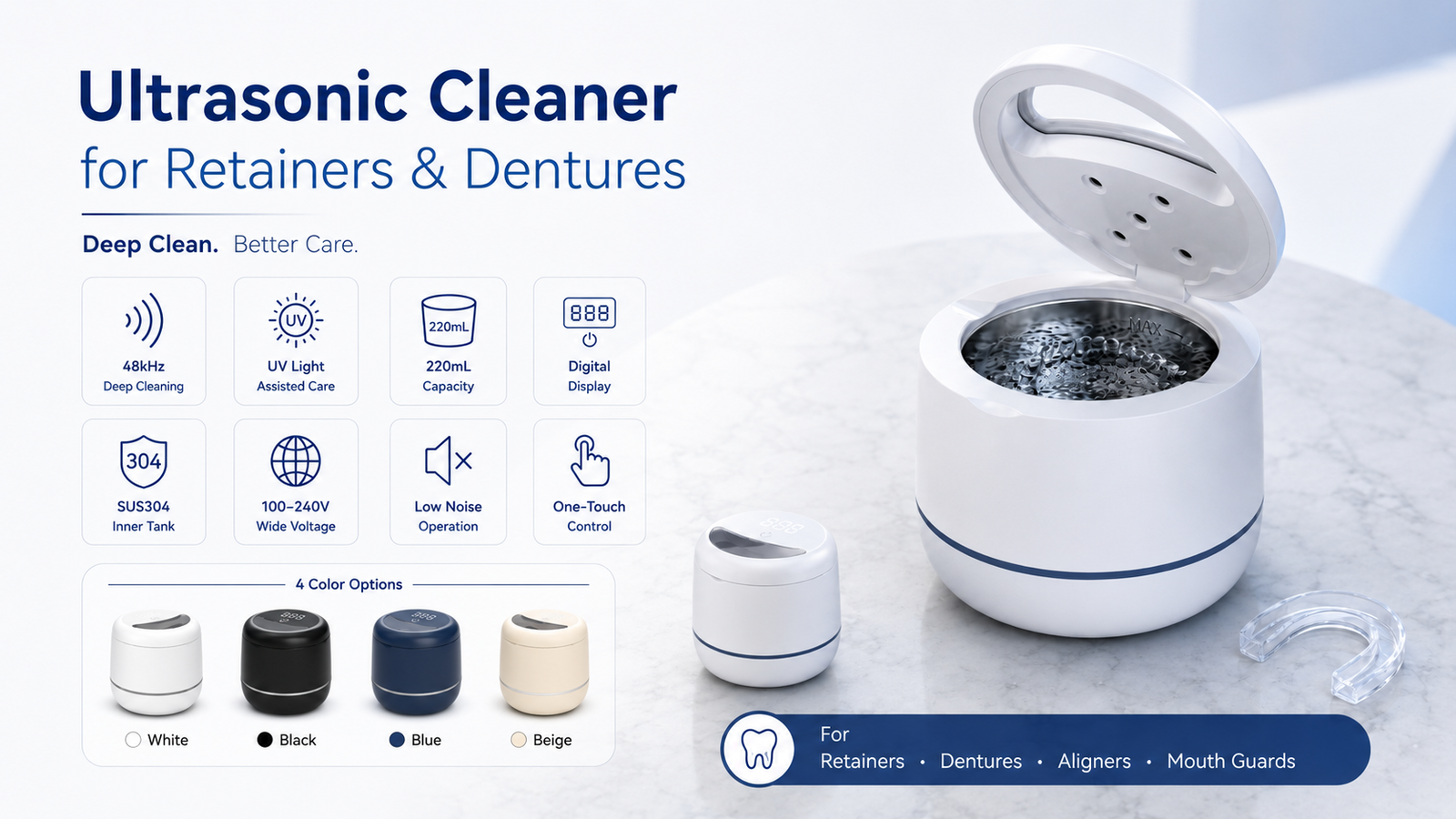
Is an Ultrasonic Retainer Cleaner Worth Using?
For people who wear retainers or clear aligners every day, the biggest benefit is not simply convenience.
It is consistency.
Manual brushing may miss grooves and recessed areas, while aggressive brushing may also scratch some clear plastic surfaces.
Research on thermoplastic orthodontic retainer materials has found that ultrasonic cleaning can effectively remove staining while causing minimal surface damage compared with mechanical cleaning in the tested conditions.
An ultrasonic cleaner provides an easy way to clean difficult areas without relying entirely on brushing.
For users who want an additional hygiene feature, a UV ultrasonic retainer cleaner can add another step aimed at microbial control.
Final Takeaway
So, can an ultrasonic cleaner for retainers really remove bacteria?
It can help remove bacteria-containing biofilm, plaque and contamination from retainer surfaces, but ultrasonic cleaning alone should not be considered sterilization.
For better hygiene, ultrasonic cleaning can be combined with an appropriate retainer-safe cleaning solution.
And for users looking for an additional level of care, a UV ultrasonic retainer cleaner combines physical ultrasonic cleaning with supplementary UV microbial inactivation.
The goal is not simply to make a retainer look cleaner.
It is to make regular, thorough retainer hygiene easier to maintain every day.